
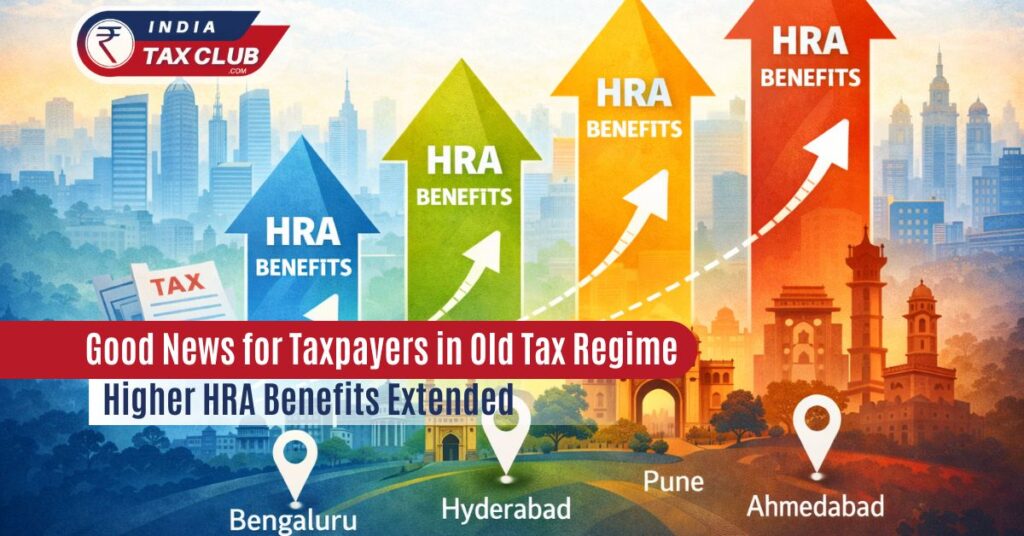
Salaried taxpayers who have stayed with the old income tax regime now have yet another reason to smile! In a significant move under the Draft Income-Tax Rules, 2026, the government is planning to extend higher House Rent Allowance (HRA) benefits to more cities — offering greater tax relief to employees living in rented accommodations. This is especially welcome given the rapidly rising rental costs in many urban centres across India.
What’s Changing?
Under the current tax rules, only taxpayers living in the four traditional metropolitan cities — Mumbai, Delhi, Kolkata, and Chennai — can claim a 50% HRA exemption (as a percentage of salary) under the old tax regime. Residents of all other cities are limited to a 40% exemption.
However, with the Draft Income-Tax Rules, 2026, this list of metro cities is set to expand. The proposal aims to include these fast-growing urban hubs:
✔️ Bengaluru
✔️ Hyderabad
✔️ Pune
✔️ Ahmedabad
If approved, taxpayers living in these cities will also be eligible for the higher 50% HRA exemption, effective from April 1, 2026.
Why This Matters
Cities like Bengaluru, Hyderabad, Pune, and Ahmedabad have evolved into major employment and tech hubs. Rental costs in these places have risen sharply in recent years, often approaching or even surpassing rents in traditional metros. Extending the 50% HRA benefit to these cities aligns tax relief with current urban realities, providing meaningful financial support to working professionals.
How HRA Tax Exemption Works
Under Rule 279 of the Draft Income-Tax Rules, 2026, the HRA exemption (amount excluded from taxable income) is the lowest of the following:
- Actual HRA received during the year
- Rent paid minus 10% of salary
- Percentage of salary
- 50% of salary (for eligible metro cities)
- 40% of salary (for all other cities)
By increasing the percentage from 40% to 50% for the newly added cities, employees can lower their taxable income, resulting in higher take-home pay.
Real-World Impact
Take an example: A taxpayer earning ₹15 lakh annually and living in Bengaluru could see a significant reduction in taxable income because of the enhanced HRA exemption. This means greater savings and more disposable income at the end of the year.
Should You Consider Staying in or Switching Back to the Old Regime?
With these revised HRA benefits, some taxpayers might find the old tax regime more attractive once again — especially if they benefit significantly from exemptions like HRA and other allowances. However, the choice between the old and new tax regimes still depends on individual income structures and deductions. It’s advisable to calculate the break-even point based on your own tax situation before making a decision.
When Will This Be Effective?
If the proposal is approved and notified by the government, the changes will be implemented from April 1, 2026, which corresponds to the Assessment Year 2026-27.
Final Thoughts
This move to expand HRA benefits under the old tax regime is a welcome reform for millions of salaried taxpayers living in major cities beyond the traditional four metros. In a period of high inflation and escalating rents, this change could deliver meaningful tax relief, enhanced take-home earnings and increased financial flexibility — especially for young professionals and employees renting homes in fast-growing urban areas.
Stay tuned to indiataxclub.com for more updates and in-depth insights on the Draft Income-Tax Rules, 2026 and how they affect your taxes!
FAQs: Higher HRA Benefits under Draft Income-Tax Rules, 2026
1. What is the major change in HRA rules under Draft Income-Tax Rules, 2026?
The draft rules propose extending the 50% HRA exemption limit (currently available only for metro cities) to new high-growth cities, giving higher tax relief to salaried taxpayers under the old tax regime.
2. Which cities are proposed to get higher HRA benefits?
As per the draft rules, the following cities are proposed to be included:
- Bengaluru
- Hyderabad
- Pune
- Ahmedabad
Taxpayers living in these cities may now claim 50% of salary as HRA exemption, instead of 40%.
3. Is this benefit available under the new tax regime?
❌ No.
HRA exemption is available only under the old tax regime. Taxpayers opting for the new tax regime cannot claim HRA benefits.
4. From when will the new HRA rules be applicable?
If approved and notified, the revised HRA rules will be effective from 1 April 2026 (Assessment Year 2026-27).
5. How is HRA exemption calculated?
HRA exemption is the least of the following:
- Actual HRA received
- Rent paid minus 10% of salary
- 50% of salary (for metro & newly added cities)
- 40% of salary (for other cities)
6. Who will benefit the most from this change?
- Salaried employees living in rented homes
- Professionals in IT, startups, and corporate sectors
- Taxpayers earning medium to high salaries in growing urban cities
7. Should taxpayers reconsider the old tax regime now?
Yes, this change may make the old tax regime more attractive, especially for those claiming HRA and other deductions. However, a tax comparison should be done before switching.