
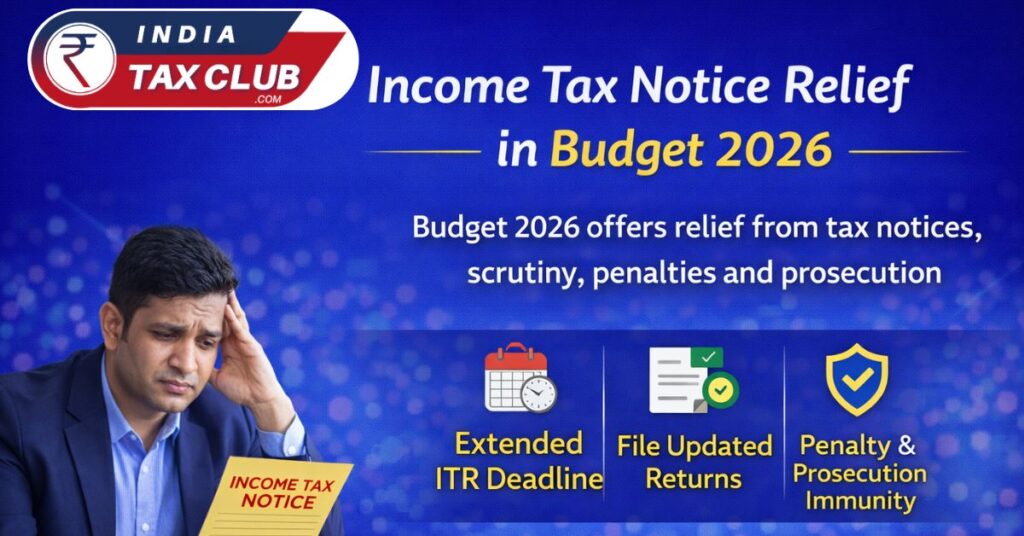
The Union Budget 2026, presented by the Finance Minister on 1 February 2026, goes beyond routine numbers — it brings some much-needed relief for individual taxpayers who have been grappling with notices, data mismatches, and fear of penalties or prosecution under the Income-tax Act.
Why Many Taxpayers Are Under Pressure
With widening use of data analytics and information exchange, the Income-tax Department now gets near-complete financial data from employers, banks, mutual funds, and even international sources. Even minor discrepancies — such as excess deductions or missing interest income — have triggered NUDGE alerts, reassessments and scrutiny notices under Sections like 148 or 143(2).
This has led to:
- Stress and confusion among salaried individuals
- Notices for mismatches in Annual Information Statement (AIS) or Taxpayer Information Summary (TIS)
- Risk of hefty penalties (up to 200 % of tax) for misreporting income under Section 270A
- Possibility of prosecution in serious cases
Major Tax Compliance Reliefs in Budget 2026
1. Extended Window to File Revised ITRs
Earlier, taxpayers could revise their Income Tax Return (ITR) only up to three months before the end of the assessment year — effectively up to 31 December.
Now, from 1 March 2026, taxpayers can file revised returns up to the end of the relevant assessment year (typically 31 March) — even after the earlier deadline has passed.
Nominal fees apply:
- ₹1,000 if total income ≤ ₹5 lakh
- ₹5,000 if total income > ₹5 lakh
This provides taxpayers a second chance to correct mistakes and avoid penalties or notices later.
2. Updated Returns Allowed Even During Reassessment
Previously, once a reassessment notice (Section 148) was issued, taxpayers could not file an updated return. Budget 2026 changes that.
Effective 1 March 2026:
✔ Updated returns can be filed even after reassessment notices are served
✔ Where notice has been issued before this date but not yet due, updated returns are allowed within the notice period
✔ For notices served on/after 1 March 2026, updated returns must be filed within the stipulated deadline in the notice.
This reform reshapes reassessment from an adversarial process into a voluntary correction mechanism.
3. Predictable Compliance Cost – Section 140B
To reduce fear and uncertainty:
Taxpayers filing updated returns now pay a predictable charge based on time since the end of the assessment year:
| Time Since Assessment Year End | Additional Percentage of Tax + Interest |
| Within 12 months | 25 % |
| Within 24 months | 50 % |
| Within 36 months | 60 % |
| Within 48 months | 70 % |
Plus, if filed after reassessment notice, an extra 10 % is added.
This is usually far lower than 200 % penalty under old rules.
4. Immunity from Penalties & Prosecution
This is perhaps the most significant relief.
Budget 2026 revises the framework under Section 270AA to provide waiver of penalty and immunity from prosecution for misreporting of income — not just under-reporting — provided conditions are met.
Key points:
✔ You must pay tax, interest, and an extra amount equal to 100 % of tax on misreported income within the specified period.
✔ On such compliance, penalty under Section 270A can be waived.
✔ You get complete immunity from prosecution under Sections like 276C and 276CC.
This means a taxpayer facing notices or even assessment orders can choose this route for clean closure instead of long legal battles.
Who Can Benefit from These Changes?
These reliefs are especially helpful if:
- You received a NUDGE alert or mismatch notice
- You overlooked some income or deduction in your original ITR
- A reassessment notice under Section 148 is pending
- You discharged demand but now face penalty proceedings
In many such cases, filing an updated or revised return with payment of due tax and additional amounts effectively resolves the dispute without penalty or prosecution — as long as time limits and conditions are met.
Important to Remember
✅ These changes apply from 1 March 2026 once the Finance Bill is enacted.
✅ They encourage honest compliance, not concealment. Taxpayers must ensure accurate income and deduction disclosure.
✅ Misreporting still incurs cost — but much smaller than past penalty exposure.
Final Word: Relief for Honest Taxpayers
Budget 2026 signals a shift in tax policy — from punitive enforcement to voluntary compliance and transparency. For many individual taxpayers intimidated by notices and scrutiny, this budget provides a practical compliance exit, a chance to fix errors, and a way to avoid harsh penalties or prosecution.
If you’ve ever wondered “Can I fix my old ITR without fear?” — the answer is: Yes, but act soon and correctly.