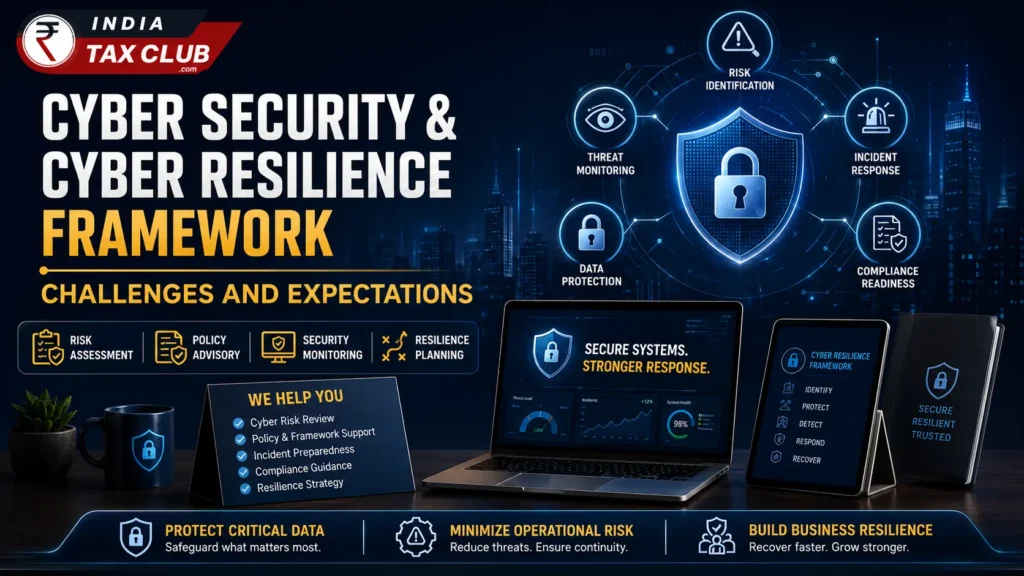
Cyber Resilience Framework Challenges and Expectations
Introduction
A cyber resilience framework helps businesses prepare for cyber threats, reduce downtime, protect sensitive data, and recover quickly from cyber incidents.
Cyber security is no longer only a technical issue. It has become a major business, compliance, governance, and risk management priority for every organization. As businesses move towards digital payments, cloud storage, online tax filing, accounting software, remote working systems, automation, and AI-based tools, cyber risks are increasing rapidly.
A cyberattack can affect business operations, customer trust, financial records, confidential documents, tax data, employee information, and statutory compliance. This is why organizations need a strong cyber security and cyber resilience framework.
Cyber security focuses on protecting systems, networks, devices, applications, and data from cyber threats. Cyber resilience goes one step further. It ensures that even if a cyber incident happens, the organization can respond quickly, recover effectively, continue critical operations, and reduce business damage.
For Indian businesses, startups, professionals, financial entities, and compliance-driven organizations, cyber resilience is becoming as important as tax compliance, internal audit, documentation, data protection, and corporate governance.
What Is a Cyber Security Framework?
A cyber security framework is a structured system of policies, controls, procedures, responsibilities, and monitoring practices designed to protect an organization from cyber threats.
It helps businesses answer important questions such as:
- What digital assets need protection?
- Who is responsible for cyber security?
- What controls are required?
- How will risks be monitored?
- How will cyber incidents be reported?
- How quickly can the business recover?
A good cyber security framework usually covers governance, access control, network security, data protection, employee awareness, vendor risk, incident response, audit review, and business continuity.
Just as businesses need proper documentation in audit to support compliance, they also need cyber security documentation to prove that appropriate controls and response mechanisms are in place.
What Is a Cyber Resilience Framework?
Cyber resilience means the ability of an organization to prepare for, withstand, respond to, and recover from cyber incidents while continuing important business operations.
Traditional cyber security focuses on preventing attacks. Cyber resilience focuses on preparedness and recovery. This is important because no organization can assume that cyberattacks will never happen. Even a strong system can be affected due to human error, weak passwords, vendor breaches, malware, phishing, software vulnerabilities, or insider threats.
Cyber resilience includes:
- Incident response planning
- Data backup and recovery
- Business continuity planning
- Disaster recovery testing
- Crisis communication
- Regulatory reporting
- Employee training
- Vendor control
- Post-incident review
A cyber resilient organization is not only protected but also prepared.
Why a Cyber Resilience Framework Matters for Indian Businesses
Indian businesses are becoming more digital. From GST filing and income tax records to payroll, invoices, bank transactions, customer databases, vendor systems, and cloud applications, most business data is now stored or processed digitally.
This increases exposure to cyber risks such as:
- Data breach
- Ransomware attack
- Business email compromise
- Phishing fraud
- Fake invoice fraud
- Unauthorized access
- Malware attack
- Cloud misconfiguration
- Payment fraud
- Insider misuse
Cyber risks can also create financial and legal consequences. For example, if a business loses customer data, employee records, tax documents, or financial information, it may face business disruption, reputational damage, compliance issues, and regulatory scrutiny.
This is why cyber security should be connected with financial fraud prevention, internal control, audit, compliance, and risk management.
Key Components of a Cyber Resilience Framework
A strong framework should help an organization achieve the following objectives:
- Protect critical systems and sensitive data
- Identify cyber risks before they become major incidents
- Define clear roles and responsibilities
- Improve monitoring and reporting
- Build incident response readiness
- Ensure faster recovery from cyber incidents
- Reduce business interruption
- Improve regulatory compliance
- Strengthen customer and stakeholder trust
- Create a culture of cyber awareness
Cyber security is not a one-time activity. It is a continuous process of assessment, implementation, monitoring, review, and improvement.
Main Components of a Cyber Security and Cyber Resilience Framework
1. Cyber Governance and Accountability
Cyber security should be treated as a governance issue, not only an IT function. Senior management should understand cyber risks and assign clear responsibilities.
A governance framework should define:
- Who owns cyber risk?
- Who approves cyber security policies?
- Who monitors incidents?
- Who handles reporting?
- Who manages vendors?
- Who reviews cyber controls?
Strong cyber governance improves decision-making and ensures that cyber security gets proper attention, budget, and monitoring.
2. Risk Assessment and Asset Identification
Before protecting systems, a business must first identify what needs protection. Important assets may include:
- Customer data
- Employee data
- Financial records
- GST records
- Income tax documents
- Payroll data
- Bank details
- Business contracts
- Email systems
- Cloud storage
- Accounting software
- Website and applications
A cyber risk assessment helps identify weak areas, high-risk systems, possible threats, and the impact of a cyber incident.
Businesses can also link cyber risk assessment with broader business compliance and audit review practices.
3. Data Protection and Privacy Controls
Data protection is one of the most important parts of cyber resilience. Businesses should know what data they collect, where it is stored, who has access to it, and how it is protected.
Important controls include:
- Data classification
- Encryption
- Secure access
- Password protection
- Data backup
- Data retention policy
- Secure deletion
- Privacy notices
- Breach response process
As data protection expectations increase in India, organizations must take privacy and data security seriously.
4. Access Control and Identity Management
Unauthorized access is one of the biggest cyber risks. Weak passwords, shared logins, excessive permissions, and poor exit controls can expose sensitive systems.
Best practices include:
- Strong password policy
- Multi-factor authentication
- Role-based access
- Limited admin rights
- Periodic access review
- Immediate removal of access after employee exit
- Monitoring of unusual login activity
Every employee should have access only to the systems and data required for their role.
5. Incident Response Planning
An incident response plan helps an organization act quickly during a cyber incident. Without a plan, businesses may lose valuable time, make poor decisions, or fail to meet reporting requirements.
An incident response plan should cover:
- How to detect an incident
- Who should be informed
- How to contain the incident
- How to preserve evidence
- How to communicate internally
- How to report to authorities, if required
- How to restore systems
- How to review the incident later
Cyber incident response should be tested through mock drills and tabletop exercises.
6. Business Continuity and Disaster Recovery
Cyber resilience depends on how quickly a business can recover after disruption. If systems go down, businesses must have a plan to continue critical operations.
A business continuity and disaster recovery plan should include:
- Backup systems
- Recovery time objectives
- Alternative communication channels
- Emergency contact list
- Critical process mapping
- Cloud recovery planning
- Manual fallback process
- Periodic recovery testing
Backups should be secure, regularly tested, and protected from ransomware attacks.
7. Vendor and Third-Party Risk Management
Many cyber incidents happen due to third-party vendors, software providers, cloud platforms, payroll vendors, payment gateways, consultants, and outsourcing partners.
Businesses should review vendor risks by checking:
- Data access given to vendors
- Security controls followed by vendors
- Vendor agreements
- Confidentiality clauses
- Incident reporting obligations
- Data backup and deletion practices
- Compliance standards
Third-party risk management is essential because a weak vendor can become a weak point for the entire organization.
8. Employee Awareness and Training
Employees are often the first line of defense against cyber threats. Many cyberattacks begin with phishing emails, fake links, malicious attachments, or social engineering.
Employee training should cover:
- Identifying phishing emails
- Avoiding suspicious links
- Reporting cyber incidents
- Password safety
- Secure use of devices
- Safe handling of client data
- Remote work security
- Email and payment fraud awareness
Cyber awareness should be repeated regularly, not conducted only once a year.
9. Monitoring, Audit, and Compliance Review
Cyber security controls must be monitored and reviewed regularly. Internal audit and compliance teams can play an important role in checking whether cyber controls are working properly.
Cyber audit may include:
- Access control review
- Backup review
- Policy review
- Vendor security review
- Incident response testing
- Log monitoring review
- Data protection review
- Compliance gap analysis
The role of audit is becoming more important in digital businesses. Readers can also explore Auditing in the Digital Era: Assurance & Digital Trust to understand how digital systems are changing audit and assurance expectations.
Challenges in Implementing a Cyber Resilience Framework
1. Lack of Cyber Awareness
Many businesses still treat cyber security as an IT expense rather than a business risk. This mindset delays investment in proper systems, training, and controls.
2. Limited Budget and Resources
Small and medium businesses may not have dedicated cyber security teams. Budget limitations often result in weak monitoring, outdated tools, and poor incident response readiness.
3. Rapidly Changing Cyber Threats
Cyber threats are constantly evolving. Attackers are using automation, AI, phishing kits, ransomware tools, and social engineering techniques. Businesses must keep updating their controls.
4. Weak Documentation
A business may have some cyber controls in place but no proper documentation. Without written policies, logs, reports, and evidence, it becomes difficult to prove compliance or respond effectively during an incident.
5. Third-Party Dependency
Businesses depend on software vendors, cloud providers, payment gateways, IT consultants, and outsourced service providers. If third-party risk is not monitored, it can create serious cyber exposure.
6. Poor Incident Response Readiness
Many organizations do not know what to do when a cyber incident occurs. Delay in response can increase damage, data loss, regulatory risk, and reputational impact.
7. Compliance Complexity
Different industries may be subject to different cyber security, data protection, reporting, and regulatory expectations. Organizations need a clear compliance roadmap to avoid confusion.
8. Human Error
Even advanced cyber systems can fail if employees click on unsafe links, share passwords, use unsecured devices, or ignore security alerts. Human error remains one of the biggest challenges.
Expectations Under a Cyber Resilience Framework
Organizations are expected to move from reactive security to proactive resilience. This means businesses should not wait for a cyberattack before taking action.
Key expectations include:
- Cyber risk should be part of business risk management
- Management should review cyber security regularly
- Policies should be documented and implemented
- Sensitive data should be protected
- Access should be controlled and monitored
- Employees should be trained
- Vendors should be assessed
- Incidents should be reported and handled quickly
- Backups should be tested
- Cyber controls should be reviewed through audit
A cyber resilience framework should help businesses build trust, reduce risk, and maintain continuity.
Cyber Resilience Framework and Business Compliance
Cyber security is closely linked with compliance, taxation, audit, legal documentation, and financial governance. Businesses storing GST records, income tax filings, customer details, employee records, invoices, agreements, and bank data must protect this information carefully.
A cyber incident may not only create IT damage but can also affect:
- Financial reporting
- Tax records
- GST compliance
- Payroll processing
- Vendor payments
- Customer confidence
- Audit evidence
- Business continuity
This is why cyber security should be included in the overall compliance and risk management framework of the organization.
Best Practices for Building a Strong Cyber Resilience Framework
Businesses can improve cyber resilience by following these practical steps:
- Create a cyber security policy
- Conduct regular cyber risk assessments
- Maintain updated asset inventory
- Use strong passwords and multi-factor authentication
- Restrict access based on job roles
- Train employees on phishing and cyber fraud
- Keep software and systems updated
- Use secure backup systems
- Prepare an incident response plan
- Test disaster recovery plans
- Review vendor cyber risks
- Maintain logs and evidence
- Conduct periodic internal audits
- Review compliance requirements regularly
- Improve controls after every incident or audit finding
Cyber resilience is built through continuous improvement.
Useful Official References
For better understanding of cyber security and cyber resilience expectations, readers may refer to official resources such as the CERT-In cyber security directions, the SEBI cyber security and cyber resilience circulars, and the NIST Cybersecurity Framework.
Role of India Tax Club in Cyber Security Awareness and Compliance Guidance
At India Tax Club, we focus on helping businesses, professionals, and taxpayers understand important compliance, audit, tax, financial, and regulatory issues.
Cyber security and cyber resilience are now important parts of modern business compliance. Businesses must protect digital records, tax documents, financial data, customer information, and statutory records to reduce operational and compliance risk.
India Tax Club provides useful knowledge resources on taxation, GST, income tax, audit, financial fraud, business registration, and compliance updates to help businesses stay informed and prepared.
Conclusion
Cyber security and cyber resilience are no longer optional for businesses. In a digital-first economy, organizations must be prepared to protect data, manage cyber risks, respond to incidents, and recover quickly from disruption.
A strong cyber security and cyber resilience framework helps businesses improve governance, reduce risk, protect sensitive information, support compliance, and build trust with customers, employees, vendors, and regulators.
The future belongs to organizations that are not only digitally active but also digitally secure and resilient.
Need guidance on compliance, audit, taxation, documentation, or business risk management? Explore more professional updates and resources at India Tax Club.